
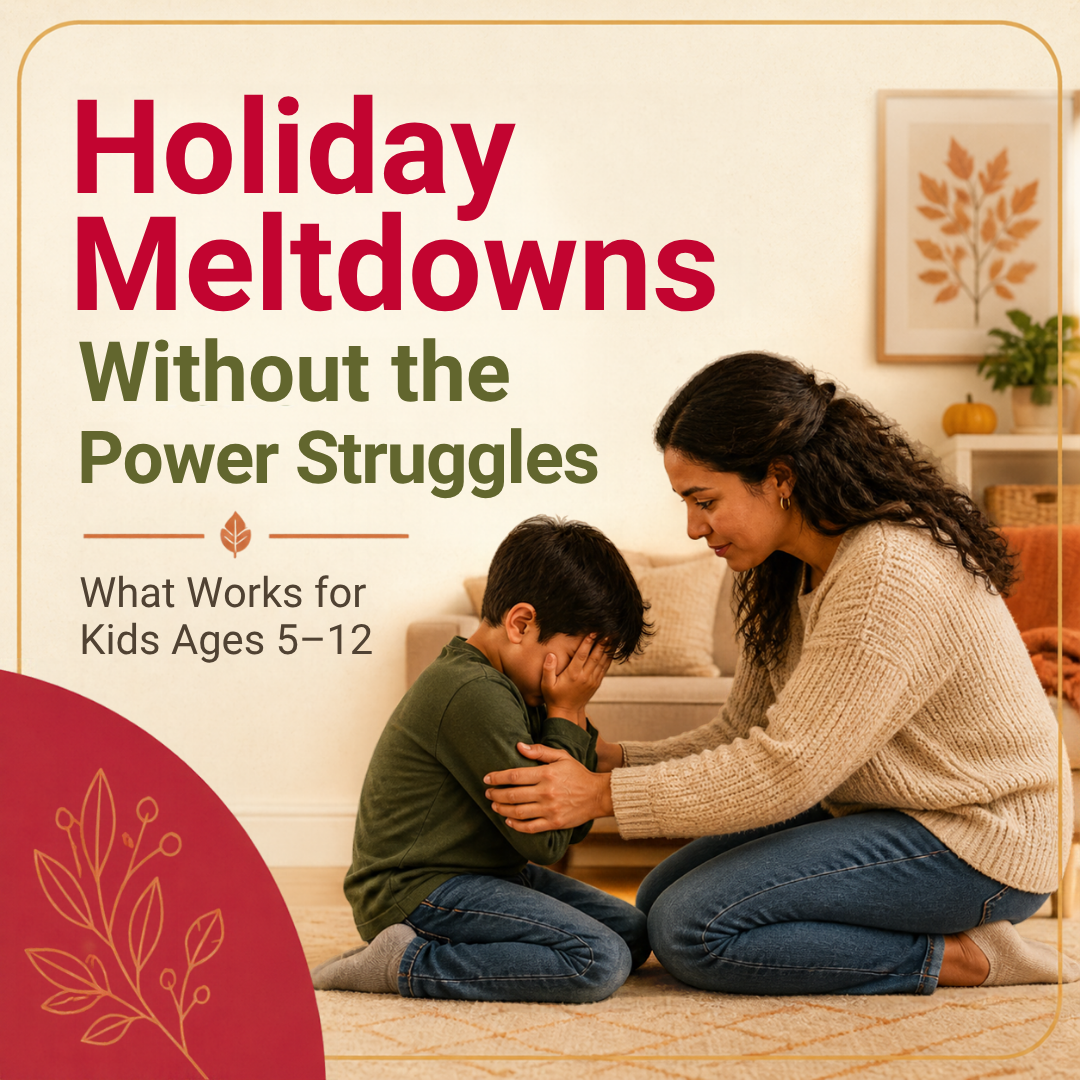
04 Nov Holiday Meltdowns Without the Power Struggles: What Works for Kids Ages 5–12
Kids and meltdowns
You’re standing in a crowded grocery line, or sitting around the dining table at a relative’s house, when it happens. Your eight-year-old completely unravels over a minor tweak in plans. Eyes turn toward you, the room grows quiet, and you feel that familiar spike of panic, cold sweat, and exhaustion. I call it the “Parent Sweat.” Part of you wants to give in so it will stop. Another part wants to abandon the cart and walk out. If you’ve ever wished you could prevent holiday meltdowns before they start, this post is for you.
If this feels familiar, you’re in good company. Between now and New Year’s, it gets more likely, not less. Holiday travel, late nights, crowded houses, and a calendar that looks nothing like a normal week all land on kids and parents at the same moment.
As Active Parenting founder Dr. Michael Popkin often reminds parents, children rarely choose the “convenient” moment to lose control. During the holidays, the sudden shifts in environment and routine test even the most resilient kids.
When your child melts down under the holiday spotlight, you don’t need judgment—you need practical, respectful tools to navigate the moment and protect your family’s connection. The good news is that holiday meltdowns are predictable, which means you can plan for them. Here’s a simple approach for kids ages 5 to 12: prevent what you can, stay calm and hold the limit in the moment, and repair afterward.
Why holidays trigger meltdowns
A meltdown usually means a child has run out of energy or skills, not that your child is “bad” or that you’re failing. In reality, the holiday season creates a perfect storm for a child’s developing brain:
- Broken Routines: Bedtimes slide, mealtimes shift, and predictable daily schedules vanish.
- Sensory Overload: Bright decorations, loud gatherings, unfamiliar smells, and constant chatter tax a child’s nervous system.
- Unclear Expectations: Kids are often expected to navigate formal family dynamics or share brand-new gifts without clear guidance.
- Physical Exhaustion: High sugar intake paired with missed sleep drains a child’s emotional battery quickly.
When internal stress exceeds a child’s ability to cope, the brain triggers a fight-or-flight response. It isn’t bad behavior—it’s a signal that your child is overwhelmed. Seeing it this way helps you prevent holiday meltdowns by responding to what’s underneath the behavior instead of only the behavior.
How to prevent holiday meltdowns before they start
Proactive discipline focuses on setting your child up for success before you ever leave the house.
- Talk Through the Plan: Tell your child what will happen, who will be there, and about how long you’ll stay. Then ask, “Is there anything about it that feels tricky?” Kids often name the very thing you were worried about, and naming it gives you both something to plan for.
- Agree on a Quiet-Break Signal: Establish a secret code word or hand signal your child can use when they feel overwhelmed and need a 5-minute break in a quiet room. Make it clear that a break is help, not punishment, and honor the signal when they use it.
- Protect Sleep and Snacks: You can’t control everything, but you can keep bedtimes close to normal when possible and pack real snacks so nobody arrives hungry. A fed, rested child handles a hard moment far better than a hungry, tired one.
- Give Your Child a Meaningful Job: Children thrive when they feel useful. Assign a specific task, let them greet guests, carry coats, set the table, or be in charge of the music. A job gives their energy somewhere to go and shows them you trust them.
- Plan for the car ride and other family trips. Family trips stack several meltdown triggers at once: long stretches of sitting, off-schedule days, and nowhere to burn off energy. Before you leave, tell your child how long the trip will take and where you’ll stop. Plan regular stretch breaks, even if no one asks for one. Let your child choose a few things for a small trip bag, such as a favorite book, a card game, and a snack they pick, and save one surprise for when patience runs thin. Treat a mid-trip break like your quiet-break signal: it’s help, not punishment.
💡 Free Resource: Connection Toolkit
Looking for simple ways to reconnect with your child after a tough moment? Download our free Connection Toolkit for quick conversation starters and de-escalation tips you can use right away.
In the moment: stay calm and hold the limit
When a meltdown starts, your calm is the most powerful tool you have. These steps keep you out of a power struggle:
- Slow down and lower your voice. Get to your child’s level if you can. Your tone sets the tone.
- Acknowledge the feeling. “You really wanted that candy, and you’re disappointed.” This isn’t giving in. It tells your child they’ve been heard, and kids calm down faster when they feel understood.
- State the limit simply. “We’re not buying candy today.” One short sentence, no lecture.
- Offer two choices you can live with. “You can hold my hand or ride in the cart.” Or: “You can take a break in the car with me, or take three slow breaths here and then help me load the bags.” Choices give your child a sense of control inside a limit that stays put.
- Follow through calmly. If it keeps going, step away together to a quiet place, or leave if you need to. Skip the bribes, threats, and negotiating, which teach kids that bigger meltdowns get better results.
It won’t look pretty every time, and that’s okay. Staying steady while your child isn’t is the skill, and it gets easier with practice. If the meltdown escalates, quietly move your child to a private space (like a quiet bedroom or your car) until their nervous system resets.
Afterward: repair and learn together
Once the storm has passed and everyone is calm, which may be later that day, a short conversation can turn a rough moment into a chance to learn. Keep it brief and kind:
- Name what happened without blame. Avoid lecturing. Simply ask: “What was hard for you back there?” or “That was a hard moment at the store.”
- Ask what they felt. “What was going on for you?
- Problem-solve together. Brainstorm what you both can do differently next time. “Next time you feel overwhelmed at Aunt Mary’s, what signal will we use?” Let your child suggest ideas, such as a snack before shopping or a job, and choose one to try.
- Encourage effort. Notice what went right: “You took a breath even though you were upset. That took courage” or “Thank you for taking those deep breaths with me. I know that was really hard.” Encouragement builds the skills you want more of, while punishment tends to build resentment.
- Repair your own part if needed. If you raised your voice, say so and apologize. It shows your child how to make things right.
What to Do When Meltdowns Keep Happening
Some meltdowns are normal at this age and occasional holiday stress is normal. But if frequent meltdowns, power struggles, or defiance happen often, last a long time, seem out of proportion, or show up in many settings, it’s worth building more skills, and it may also help to talk with your child’s doctor or school counselor.
Learning core parenting skills—like mutual respect, active listening, and logical consequences—gives you a clear roadmap for every stage of your child’s growth. Knowing what to do is different from doing it when you’re tired and everyone is watching. Practice helps. Parenting classes are designed for parents of kids ages 5 to 12, with practical tools for handling meltdowns, building cooperation, and encouraging your child, plus room to practice before the next hard moment.
- 👉 Parents: Learn more about the Active Parenting 4th Edition Online Parenting Class for Ages 5–12 or find a class near you.
- 👉 Leaders: Explore our curricula for parents of ages 5-12 and accompanying Leader Training (Live Webinar or Self-study online training). Request a quote and we’ll hold Black Friday pricing for 30 days so you can get budget approval.
- 📢 Get Early Discount Access: Sign up for our Leader Connection today to receive an exclusive Black Friday discount code straight to your inbox!
- 📚 Explore Related Resources: Check out our comprehensive Resilience Toolkit for building emotional strength in school-age children.
👨👩👧👦 Information for Group Leaders & Educators
Are you a school counselor, parent educator, or community leader looking to support families in your network this season?
- Share this post: Pass these tips along in your next parent newsletter or group discussion.
- Explore Program Tools: Try our Free Program Preview to see how Active Parenting materials fit your organization.
- Expand Your Impact: Ready to host classes in your community? Complete our Grow Your Program Form to connect with an educational consultant.
❓ Frequently Asked Questions
Why does my child melt down more during the holidays?
Children rely heavily on predictable daily routines to feel secure. During the holidays, disrupted sleep, richer foods, more sugar (& noise), unfamiliar environments, and increased social expectations overwhelm their sensory and emotional self-regulation capacities, so kids use up their coping skills faster. Planning ahead, protecting sleep and snacks, and talking through what will happen can reduce the chance of a meltdown.
How can I prevent holiday meltdowns during family trips?
Start before you leave. Tell your child where you’re going, how long it will take, and what to expect when you arrive. Pack real snacks and a few activities your child chooses, and plan regular stops so they can move. Keep sleep as close to normal as you can, and agree on a quiet-break signal for the car and for the gathering. If a meltdown still happens, stay calm, acknowledge the feeling, state the limit, and offer two choices.
Should I give in to stop a meltdown?
It may end the moment, but it teaches your child that melting down works. A better approach is to acknowledge the feeling, hold the limit kindly, and offer two choices. Calmly holding the limit helps kids learn it, which makes the next meltdown less likely.
How do I handle family members who criticize my parenting during a meltdown?
Stay focused on your child rather than arguing with relatives. A simple, polite response like, “We’re taking a quick break to reset, and we’ll be right back,” keeps the focus on your child’s needs while maintaining firm personal boundaries. Try not to give too much weight to outside opinions, they are not there for the day to day and you’re raising your child, not performing for the room.
Should I punish my child after a public meltdown?
No. Meltdowns are a sign of emotional overload, not intentional misbehavior. Punishing a child after they have already calmed down teaches fear rather than self-control. Instead, wait until everyone is calm and focus on problem-solving together for the next time.
For leaders: share this with your parent group
If you lead parenting classes, this post makes a good conversation starter for your group. Try the prevent, hold the limit, and repair steps as a discussion or role-play. If you’d like to reach more parents with a ready-to-teach program, see the Free Preview or fill out the Grow Your Program form and we’ll help you get started.
More for the season
- Resilience Toolkit
- Holiday Survival Guide: Tips for Reducing Stress During the Holidays
- The Importance of Holiday Traditions
- Leading a class for parents of younger children – check out this blog: Little Kids, Big Feelings: Emotional Regulation

Active Parenting Publishers has been providing research-based education programs with an emphasis on nonviolent discipline, mutual respect, and open communication for over 40 years.
STAY IN TOUCH!
Click here to receive the latest news and offers from Active Parenting! And follow us on social media: