
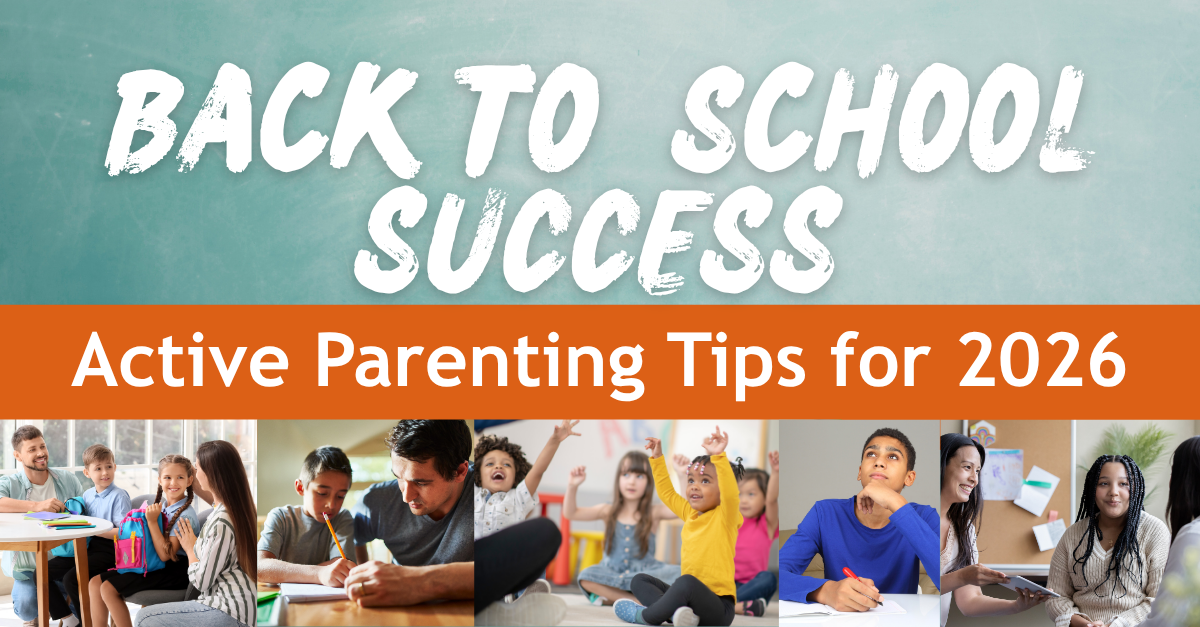
02 Aug Back-to-School Success: Active Parenting Tips for 2026
The back-to-school season is upon us, bringing a mix of excitement and anxiety for both parents and children. As a parent educator or school counselor, this transition is your peak opportunity to connect with your community because parents are actively looking for structure. Active Parenting is here to help with school-success tips you can share with the parents in your upcoming fall classes, along with tools to help you seamlessly launch your fall programs. Whether the children are starting kindergarten or heading back to high school, these tips can make this transition as smooth and successful as possible.
Establishing Routines Without Power Struggles
One of the biggest challenges families face during the back-to-school season is the sudden shift from relaxed summer schedules to structured school days. Morning rushes, bedtime battles, and homework conflicts can quickly create stress for both parents and children.
What to teach parents:
Co-Create Routines: Encourage parents to begin rebuilding routines before problems arise. Advise parents to start adjusting sleep schedules and mealtimes a week or two before school starts to help their child’s body get back into a school-ready rhythm. Rather than issuing commands, teach parents to involve children in creating a plan by asking open-ended questions like:
- What time do you think you need to wake up to avoid feeling rushed?
- What can we do the night before to make mornings easier?
- How can our family work together to make school days less stressful?
Encourage Responsibility: Teach parents how to help their children develop organizational skills and take genuine ownership of their schoolwork. Show parents how to guide their kids in using a simple paper planner, family white-board calendar, or digital calendar to track assignments, test dates, and extracurricular deadlines. Parents can encourage children to set realistic academic and personal goals for the year. Setting goals gives children a sense of direction and helps them take ownership of their learning while boosting motivation.
Celebrate Success: Remind parents to notice, acknowledge, and celebrate their child’s achievements and positive efforts, both big and small. Celebrating progress—like getting out the door on time or finishing a tough homework assignment—builds ongoing confidence, self-esteem, and internal motivation to keep up the good work.
The Active Parenting Principle (Collaboration for Cooperation, Responsibility, & Encouragement) : When children help create the routine, they are more likely to cooperate with it. And when children take responsibility for their work and schedule, they develop self-discipline and can take pride in their independence. Remind parents to use encouragement instead of constant nagging and to focus on progress rather than perfection.
🎒 Special Resource for Parent Instructors
Are you planning your fall class lineup?
Don’t let empty seats stall your program’s impact. Download our free Active Parenting Turnout Toolkit—packed with ready-to-use flyers, recruitment strategies, and customizable social media assets designed to fill your rosters.
Helping Children Manage Back-to-School Anxiety
While many children look forward to seeing friends and teachers again, others may feel nervous, overwhelmed, or uncertain about the new school year. New classrooms, unfamiliar teachers, changing schedules, academic expectations, and social pressures can all contribute to anxiety.
What to teach parents:
Active Listening First: Advise parents to support children by creating opportunities for open conversation. Instead of immediately jumping in to “fix” or minimize the problem, parents should start by listening actively. Share these discussion starters with your class:
- What are you most excited about this year?
- Is there anything you’re worried or uncertain about?
- What would help you feel more prepared?
Then Problem-Solving Together: When a child faces specific obstacles at school—whether it’s managing a busy schedule or navigating social dynamics—teach parents to walk through Active Parenting’s problem-solving steps together. Encourage parents to ask: “What do you think are two or three ways you could handle this?” or for social conflict: “Sounds like you both want different things. What’s a solution you can both agree on?” Remind parents to follow-up with Active Listening again to see how their child’s solution worked out. It may not always turn out the way you hoped but parents can brainstorm with their teens again to try a new approach or cope with consequences.
The Active Parenting Principle (Fostering Resilience with Active Listening & Problem-solving): When children feel heard, they develop emotional resilience and confidence in their ability to handle challenges. Remind children that feeling nervous is normal and that many students experience similar emotions during the first weeks of school. Effective problem-solving isn’t about solving issues for children; it’s about guiding them to find their own solutions. When parents invite children to think creatively and take initiative, kids develop long-term problem-solving skills, independence, and the confidence to handle future setbacks.
Creating Healthy Technology Boundaries for the School Year
Summer often brings increased screen time and relaxed rules around technology. As school begins, families benefit from revisiting expectations for phones, gaming, social media, and online entertainment.
What to teach parents:
Help parents shift their mindset from purely enforcing restrictions to thinking about how technology can support family goals. Encourage them to establish clear baseline guidelines, such as:
- Keeping mealtimes completely device-free.
- Establishing a dedicated, technology-free family connection time each evening.
- Ensuring schoolwork is completed before recreational screen time.
- Charging all devices outside of bedrooms overnight to protect sleep.
The Active Parenting Principle (Collaboration instead of Control for Cooperation): For preteens and teens especially, collaboration works better than control. Teach parents to invite teens into the conversation and discuss the reasons behind the rules. Explain that healthy technology habits are not about punishment but about protecting sleep, mental health, academic success, and family relationships.
When parents model balanced technology use themselves, children are much more likely to follow suit.
~ For a deep dive into this topic, see our blog: Internet Safety: An Active Parenting Approach, which includes a printable Digital Safety Checklist and a Family Media Plan template you can share with your groups. ~
Strengthening Family Communication During Busy Seasons
As schedules become busier, family communication often becomes shorter and more focused on logistics:
“Did you finish your homework?”
“Don’t forget practice tonight.”
“Did you turn in that form?”
While these conversations are necessary, families also need time to connect on a deeper level.
What to teach parents:
Encourage parents to set aside a few minutes each day after school or during dinner to ask open-ended questions like:
- What was the best part of your day?
- What was the most interesting thing you learned today?
- What challenged you today?
- Who helped you this week?
- What are you proud of?
- What are you looking forward to tomorrow?
The Active Parenting Principle (Active Listening): Active listening is one of the most powerful tools a parent has. When parents listen first and talk second, children learn that their thoughts and feelings truly matter. This builds long-term trust, creates stronger family relationships, reduces daily conflict, and keeps families connected throughout the busy school year.
Building Strong Partnerships with Teachers
Parents and teachers share a common goal: helping children succeed. When families and educators work together, children benefit academically, socially, and emotionally.
What to teach parents:
At the beginning of the school year, parents can:
- Introduce themselves to teachers.
- Share important information about their child.
- Attend school events when possible.
- Respond promptly to communications.
- Keep in mind that their child is part of a larger classroom community.
- Focus on collaboration rather than criticism.
When challenges arise, approach conversations with curiosity and a problem-solving mindset. Asking, “How can we work together to help my child succeed?” often leads to better outcomes than focusing on blame.
For parent educators, this is an important message to reinforce in classes. Parenting education supports school goals by helping families improve communication, strengthen relationships, and become active partners in their children’s education.
The Active Parenting Principle (Partner with Teachers): Strong families and strong schools create stronger communities, and the beginning of a new school year is the perfect time to build those partnerships.
💡 Leader Tip: Want to help parents support what teachers are doing in the classroom? Point them toward our SEL Conversation Starters Toolkit (featured in the Active Parenting Resources section below) to help families build social-emotional skills at home that align directly with school goals!
Practical Tips for Parents by Age & Stage
Transitioning back to school looks different at every stage of a child’s development. Here is how you can help parents navigate these transitions, organized by the each age group:
-
The Early Years (Ages 0–5): Overcoming Separation Anxiety
For parents of children entering preschool, pre-K, or kindergarten, the biggest hurdle is often the emotional transition of separating from caregivers.
- Establish Predictable Routines: Leaders, work with parents to practice a consistent goodbye routine. A quick, loving, and predictable departure reduces a child’s anxiety much more effectively than a prolonged exit.
- Encourage Independence: Parents can help young children practice school skills at home, like putting on their own shoes, zipping their backpacks, and washing their hands.
Program Connection: Fostering school readiness and helping parents understand early developmental milestones is the core of our First Five Years program.
-
School-Aged Children (Ages 5–12): Minimizing Morning Power Struggles
As homework, structured schedules, and extracurricular activities increase, so does the potential for daily friction at home.
- The Method of Choice: Encourage parents to offer limited choices to reduce pushback (e.g., “Do you want to pack your lunch tonight, or do it tomorrow morning before we leave?” and “Do you want to wear the blue shirt or the red shirt tomorrow?”). Parents should only offer choices they can accept. This gives the child a sense of power while keeping the routine moving forward.
- Create a Dedicated Study Space: Help kids establish a consistent, distraction-free “homework zone” to build strong study habits early.
Program Connection: Teaching parents how to defuse power struggles using mutual respect and the Think-Feel-Do Cycle is central to Active Parenting 4th Edition (Ages 5–12).
-
Preteens & Teens (Ages 12–18): Balancing Autonomy & Support
Middle and high school transitions bring academic pressure, complex social dynamics, extracurricular commitments, a strong desire for independence, and major developmental changes all at once. While parents often become more focused on grades and responsibilities during this time, teens still need connection just as much as younger children do.
- Encourage Joint Problem-Solving: Instead of dictating a teen’s schedule, invite them to help design their own routines. Ask: “What do you think is a realistic way to balance your homework, sports practice, and screen time this semester?”
- Watch for Signs of Stress: Educate parents to look for subtle shifts in behavior—such as sudden social withdrawal, changes in sleep patterns, or unusual irritability—which can signal back-to-school mental fatigue or anxiety.
- Connect: Have parents look for opportunities to:
- Listen without immediately giving advice.
- Ask open-ended questions.
- Show interest in their goals and concerns.
- Respect their growing independence.
- Maintain clear expectations and boundaries.
The most effective relationships are built on mutual respect. When teens feel understood and valued, they are more likely to communicate openly and make responsible decisions.
A simple check-in during a car ride, at dinner, or before bedtime can create meaningful opportunities for connection throughout the school year.
Program Connection: Helping parents to navigate the delicate balance between giving teens autonomy and maintaining firm family boundaries is the focus of our Teen Programs.
Don’t Forget Self-Care:
Remember, a successful school year starts with a well-rested and supported parent. Remind parents to prioritize their own well-being, and that they shouldn’t hesitate to ask for help when needed. Taking time for self-care isn’t selfish—it models a crucial skill for children, showing them that asking for help and taking care of one’s mental health is both necessary and healthy.
🛠️ The Leader’s Launch Toolkit: Tools to Fill Your Fall Classes
Having a great parenting curriculum only works if you can fill your seats! To help you launch your fall sessions with confidence, we have compiled our top resources for parent educators and program coordinators:
1. Download the Free Turnout Toolkit
Solve recruitment challenges with ready-to-use flyers, outreach strategies, an enrollment checklist, and father-engagement tips.
👉 Click here to sign up for The Leader Connection and unlock your free Turnout Toolkit!
2. Access Free Promotional Materials
You don’t have to design your promotional assets from scratch. Head over to our Promoting Your Classes page to list your class on our website and download program-specific tools like customizable promotional flyers, content for emails or press releases, and social media graphics to help you share your upcoming class dates online.
3. Let Us Help You Reach Your Goals
Take a couple of minutes to fill out our quick Smart Form to share your program goals, and our team will connect you with tailored system support and resources. Or, book a quick call to get one-on-one support!
4. Pitch Your Class at Back-to-School & PTA Meetings
Early fall school events are the best place to meet parents where they are. Reach out to your local principal or PTA board now to secure a 3- to 5-minute spot at an upcoming meeting to introduce yourself, highlight 2 or 3 universal challenges your class solves (like morning routines and screen time), and pass around a sign-up sheet to fill your roster!
Active Parenting Resources: Looking for More to Offer?
We’ve got you covered! Sign up for our educator newsletter, The Leader Connection, to receive actionable teaching tips, parenting insights, and exclusive free tools delivered straight to your inbox just three times a month.
When you join our community of educators, you’ll unlock instant access to high-impact resources like:
- The Family Reading Challenge Toolkit: A turn-key kit designed to help leaders inspire families to read together, featuring reading trackers, secure attachment talking points, and more to share with parents.
- The Connection Toolkit: A practical set of resources aimed at strengthening parent-child relationships using core Adlerian principles. It features simple family bonding exercises, communication prompts, and tools to help families navigate emotional transitions together.
- SEL Conversation Starters Toolkit: Daily prompts and discussion cards designed to help parents build emotional intelligence, resilience, and healthy social-emotional habits at home that directly align with school success goals.
👉 [Click here to sign up for The Leader Connection and unlock your free toolkits!]
Grounded in Evidence-Based Principles
The strategies in this guide, as in all of our programs, aren’t just practical—they are rooted in research-backed principles:
-
Choice Within Limits (“Method of Choice”)
- Study: Parent Provision of Choice Is a Key Component of Autonomy Support in Predicting Child Executive Function Skills (2022)
- Source: National Center for Biotechnology Information / PubMed (NIH)
- Key Finding: Evaluated subscales of autonomy support and found that parental offering of choice was the most consistent direct predictor of executive function and self-regulation skills in young children.
-
Co-Creating Routines & Shared Responsibility
- Study: Routines as a Protective Factor for Emerging Mental Health and Behavioral Problems in Children (2024)
- Source: National Institutes of Health (NIH / PMC)
- Key Finding: Demonstrates that structured, predictable household routines significantly reduce externalizing behavior issues, support cognitive and social-emotional development, and lower parental stress.
-
Technology Boundaries & Sleep Hygiene
- Study: Association Between Portable Screen-Based Media Device Access or Use and Sleep Outcomes
- Source: JAMA Pediatrics (Journal of the American Medical Association)
- Key Finding: Meta-analysis confirming strong associations between night-time screen presence in bedrooms and reduced sleep duration, poor sleep quality, and daytime fatigue—supporting rules like charging devices outside bedrooms.
-
Parent-Teacher Partnerships
- Research Project: A Meta-Analysis of Parent Involvement Interventions and Family-School Partnerships’ Effects on Student Outcomes
- Source: Institute of Education Sciences (U.S. Department of Education) / Nebraska Center for Research on Children, Youth, Families & Schools
- Key Finding: Decades of aggregated research showing that relational family-school partnership models directly improve academic achievement, social-emotional development, and classroom behavior from pre-K through high school.
-
Active Listening & Problem-Solving
- Resource / Overview: Active Listening and Collaborative Problem-Solving in Child Development
- Source: American Psychological Association (APA) & Society of Clinical Child and Adolescent Psychology
- Key Finding: Active listening validates child emotions, reducing physiological stress markers and facilitating collaborative cognitive problem-solving instead of defensive emotional reactions.
Additional Resources:
Let’s make this an impactful and successful school year!
Contributing Author: Eryn Hopkins

Active Parenting Publishers founder and president Michael H. Popkin, Ph.D. has been providing research-based education programs with an emphasis on nonviolent discipline, mutual respect, and open communication for 40 years. He is widely known for his expertise in the field of parent education and has appeared on over 100 TV programs, including CNN and The Oprah Winfrey Show.
STAY IN TOUCH!
Click here to receive the latest news and offers from Active Parenting! And follow us on social media:




Copyright 2024 by Active Parenting Publishers, Inc.