
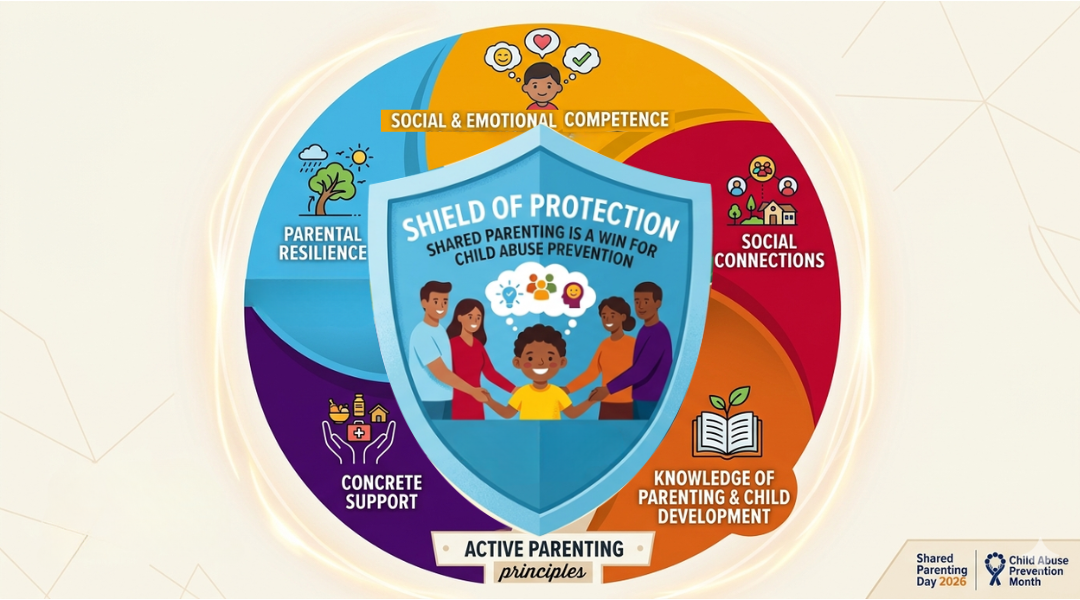
22 Apr Shared Parenting Is a Win for Child Abuse Prevention
A Powerful Time for Families
April is a significant month for families. As we observe both National Child Abuse Prevention Month and Shared Parenting Day, we are reminded that the strongest shield we can provide for our children is a healthy, supportive, and connected family environment.
At Active Parenting, we believe that “prevention” isn’t a single event—it’s a relationship that evolves. Whether parents are living in the same household or co-parenting from different homes, the goal remains the same: creating a stable foundation where children can thrive. Children do best when adults work together—across households, schedules, and stressors.
Using Active Parenting principles, shared parenting becomes more than a custody arrangement or scheduling solution. It is a protective factor—one that reduces the risk of neglect and abuse by lowering parental stress, building consistency, and creating safer environments for children across homes. This moment invites families, professionals, and communities to view shared parenting through a prevention lens—focusing on cooperation, connection, and children’s well-being.
The Science of Prevention: The 5 Protective Factors
At Active Parenting, we align our prevention efforts with the 5 Protective Factors framework. These aren’t just academic concepts; these evidence-based pillars serve as a safety net that helps families thrive, even in challenging times.
These Protective Factors reduce the risk of maltreatment by empowering parents with the tools they need to handle the stresses of modern life:
- Parental Resilience: The ability to manage stress and function well when faced with challenges.
- Social Connections: Having a network of support to lean on.
- Knowledge of Parenting & Child Development: Understanding what children need for healthy development at each age.
- Concrete Support: Access to basic necessities during difficult periods.
- Social and Emotional Competence: Helping children identify, express, and regulate their feelings safely.
When these factors are strengthened together, families are better prepared to manage change, conflict, and complexity before crises emerge.
Shared Parenting and Child Abuse Prevention: A Natural Connection
One of the most significant predictors of child neglect and abuse is chronic, unmanaged parental stress. Financial pressure, isolation, inconsistent expectations, and unresolved conflict between caregivers can overwhelm even the most committed parents.
Prevention efforts are most effective when they:
- Reduce stress
- Strengthen skills
- Increase support
That’s exactly where our coparenting programs shine. When shared parenting is supported by skill‑building and structure, it directly addresses these risk factors by distributing responsibility and reinforcing consistency across homes.
Shared parenting strengthens Protective Factors when caregivers are equipped with skills that foster resilience, supportive relationships, understanding of child development, and emotional competence—for themselves and their children.
From Theory to Impact: Turning Principles into Practice
For Parent Educators and agency leaders, the challenge is often: How do we teach these factors in a way that sticks?
This is where evidence-based programs become essential. It’s not enough to tell a parent to be “resilient”; we must provide them with the communication skills, logical consequence concepts, and non-violent discipline strategies that make resilience possible. When parents feel empowered and competent, the risk of maltreatment drops significantly.
Active Parenting emphasizes mutual respect, clear communication, connection, and shared leadership across all adults involved in a child’s life. When caregivers coordinate instead of compete, children experience greater stability—and adults gain relief. Less emotional overload. Fewer power struggles. More capacity to respond calmly, consistently, and safely.
Shared parenting isn’t about splitting time perfectly. It’s about sharing responsibility and centering children’s well-being—even when caregivers live in different homes.
How Cooperative Coparenting Protects Children
1. Shared Responsibility Lowers Parental Overload
When one adult carries all the emotional labor, decision-making, and daily logistics, burnout becomes inevitable. Cooperative coparenting shares responsibilities—from routines and discipline to school and healthcare decisions—reducing emotional reactivity that can escalate risk.
Active Parenting principle in action:
Planning together replaces reactive discipline with thoughtful guidance.
2. Consistency Across Homes Creates Safety
Children feel safest when expectations are predictable. Consistent routines, limits, and encouragement across households lower anxiety and reduce behavioral challenges—common stressors that can trigger harsh responses under pressure.
Active Parenting principle in action:
Predictability builds trust. Trust fosters cooperation. Cooperation helps prevent crises.
3. Respectful Communication De-escalates Conflict
Conflict between adults is stressful for children and exhausting for parents. Active Parenting teaches assertive—not aggressive—communication, helping caregivers solve problems without blame, name-calling, or escalation.
Active Parenting principle in action:
Focus on cooperation and solutions, not winning arguments.
4. Strong Adult Networks Are Key Protective Factors
One of the core principles of child abuse prevention is connection. Children benefit from multiple engaged adults who share responsibility for safety, guidance, and emotional support. Parents benefit from knowing they are not alone—especially during challenging times.
Active Parenting principle in action:
Community and connection strengthen families.
Connection for Every Stage & Every Step
While the core of prevention is a strong bond, that bond looks different as a child grows. To ensure a comprehensive safety net, we focus on three distinct stages of connection:
- Early Childhood (Attachment): In the first five years, connection is built through secure attachment. When a child knows their needs will be met with consistency and warmth, they develop the fundamental trust required for healthy brain development.
- School Age (Communication): As children enter school, connection shifts toward active listening and mutual respect. This stage is about teaching children how to solve problems with cooperation rather than conflict.
- The Teen Years (Resilience): For teens, connection is the ultimate protective factor against modern risks. By maintaining an open line of communication and a “connection before correction” mindset, parents provide a safe harbor during the often-turbulent adolescent years.
By focusing on these bonds, we don’t just support children; we actively protect them.
Why Parenting Education Makes a Difference
Awareness alone does not prevent abuse—education does.
During Child Abuse Prevention Month, the focus must move from intention to action. Parenting education certification equips professionals and caregivers with evidence-based tools that help families navigate shared parenting with confidence instead of conflict.
Programs grounded in Active Parenting help adults:
- Set realistic expectations rooted in child development
- Use non-violent, effective discipline strategies
- Build cooperation rather than control
- Communicate consistently and cooperatively across households
For professionals, shared training also creates a common language and shared approach, particularly valuable when working with blended families, court-involved parents, and complex family systems.
Cooperative Shared Parenting Isn’t Always Easy—but It’s Powerful Prevention
Shared parenting requires effort, emotional regulation, and intentional communication. Prevention work often does. But the payoff is profound.
When adults model cooperation, empathy, and problem-solving, children learn those same skills. These lessons don’t just protect children today—they build resilience for the future.
As we honor Shared Parenting Day 2026, let’s elevate shared parenting as a child abuse prevention strategy, not just a family arrangement.
When adults share leadership, communicate respectfully, and use effective, non-violent discipline skills, they create safer, more stable environments for children—across households, schedules, and life’s inevitable stressors.
Resources for Building Stronger Families
FOR LEADERS: The work of building these protective factors starts with you. Explore our evidence-based programs that turn these theories into actionable skills for the families you serve.
We also offer professional training to help you make a positive impact in your community. Start with a Leader Training Workshop LIVE Webinar or self-paced, online workshop to learn how to lead Active Parenting classes, then join us for our July Training of Trainers (TOT). This in-person event is designed specifically for professionals looking to become certified to train other Active Parenting Leaders and help more families.
Explore our Cooperative Coparenting Leader Training Workshop: Learn how to teach coparenting skills that reduce stress, increase consistency, and protect children.
DOWNLOAD: Get your free Child Abuse Prevention Month Toolkit, featuring social media assets and a prevention tips poster to share with the families in your community.
FOR PARENTS: Strong families start with the right tools and a community of support. Find a class near you or register for a convenient online parenting class to learn positive ways to connect with your child.

Active Parenting Publishers has been providing research-based education programs with an emphasis on nonviolent discipline, mutual respect, and open communication for over 40 years.
STAY IN TOUCH!
Click here to receive the latest news and offers from Active Parenting! And follow us on social media: